Land Title Verification in Haryana: What Buyers Must Check
A title that looks clean on the surface can carry undisclosed disputes, unpaid mortgages, or ancestral ownership claims that surface only after registration. This guide covers the specific checks buyers must complete before any property transaction in Haryana.
PROPERTY LAW
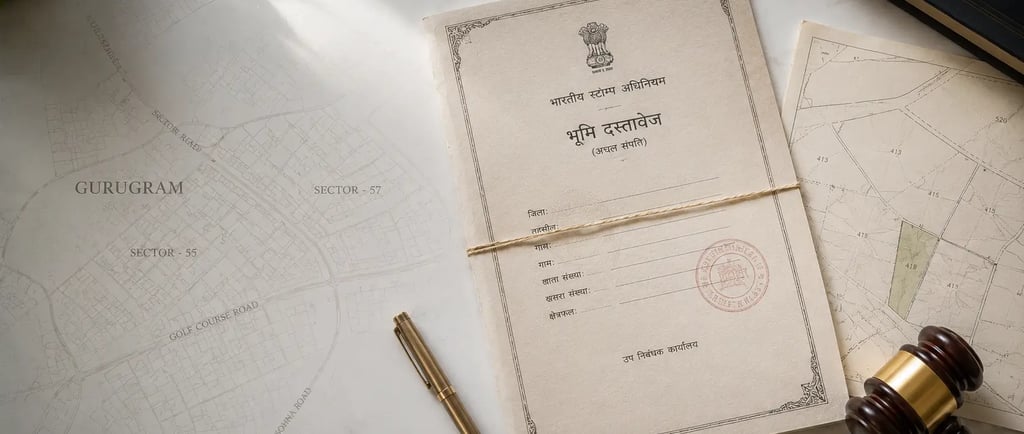
Buying property in Haryana — whether a flat in Gurugram, agricultural land near Manesar, or a plot in Faridabad — is one of the largest financial commitments most people make. Yet a surprising number of buyers skip or rush the one step that determines whether ownership is actually theirs to keep: title verification.
A title that looks clean on the surface can carry undisclosed disputes, unpaid mortgages, or ancestral ownership claims that surface only after registration. This guide covers the specific checks buyers must complete before any property transaction in Haryana.
Why Haryana Requires Special Attention
Haryana's land record system is distinct. Much of the state's land, particularly in and around Gurugram, sits on what were originally agricultural or revenue village parcels — Lal Dora land, Abadi Deh plots, or parcels converted under various government schemes. Urban expansion has overlaid this revenue record system with HRERA regulations, DTCP approvals, and HSVP sector layouts, creating a multi-layered framework that buyers must navigate carefully.
A 2025 Gurugram case exposed a ₹200 crore fraud where a flat that did not physically exist was allegedly sold for ₹12 crore — underscoring how sophisticated property fraud has become and why professional due diligence is non-negotiable.
The Core Checks: What to Verify Before You Sign
1. Jamabandi (Record of Rights)
The Jamabandi is the foundation of any title verification in Haryana. It records ownership, share of land, possession status, and any rights or tenancies attached to the property. Access it online through the Haryana Jamabandi portal (jamabandi.nic.in) or through a property lawyer who can obtain certified copies from the relevant Patwari.
Verify that the seller's name, their father's name, and their land share match the documents presented to you. Any mismatch is a serious red flag.
2. Intkal (Mutation Records)
Mutation is the process by which a new owner's name is recorded in the revenue records after a sale or inheritance. If the seller purchased the property but never got mutation done, their name will not appear in the current Jamabandi — meaning the revenue record still names someone else as owner.
Check the complete chain of Intkal entries going back at least 12 to 30 years to trace unbroken ownership.
3. Title Deed and Chain of Title
Obtain the original sale deed and trace every transfer of ownership from its source. Each conveyance must be registered with the Sub-Registrar. Any gap in the chain — a period where a deed is missing, unregistered, or executed through Power of Attorney rather than a registered sale deed — is a point of vulnerability.
The Supreme Court's ruling in Suraj Lamp & Industries Pvt. Ltd. v. State of Haryana made clear that property transfers via GPA/SA/Will arrangements without registered sale deeds do not confer valid title.
4. Encumbrance Certificate
An Encumbrance Certificate from the Sub-Registrar's office shows all registered transactions on the property within a given period — mortgages, charges, attachments, and other encumbrances. If the seller has a home loan secured against the property, you must obtain a No Objection Certificate from the lending bank and verify the loan is fully discharged on the CERSAI portal (cersai.org.in) before proceeding.
5. RERA Registration (for Projects)
For any under-construction project, builder-buyer flat, or plotted development, verify registration on the Haryana RERA portal (haryanarera.gov.in). RERA registration confirms that the project has cleared basic regulatory approvals and that the builder is legally permitted to market and sell units. Never advance money to a project not registered under HRERA.
6. Land Use and Zoning Clearance
Confirm that the land use is consistent with your intended purpose. Agricultural land in Haryana cannot legally be used for residential construction without change of land use (CLU) approval. Proximity to the Aravalli zone, controlled areas around Gurugram, or HSVP sectors carries additional restrictions. Verify the CLU order and DTCP approvals with the relevant authority.
7. Property Tax and Utility Clearances
Outstanding property tax dues, unpaid maintenance charges in a housing society, or pending electricity and water dues can become your liability after purchase. Obtain receipts confirming all dues are cleared up to the date of transaction.
The Property Due Diligence Checklist for Gurugram Buyers
Why a Property Lawyer Is Not Optional
Property due diligence in Haryana involves reading revenue records in local terminology — Khewat, Khatoni, Khasra numbers — cross-referencing them against registered documents, spotting gaps in title chains, and assessing litigation risk. These are legal skills. A lawyer who regularly handles property matters in Gurugram will also know which micro-markets carry elevated risk, which types of GPA transactions are contested, and whether a particular seller's documents are consistent with local practice.
Engaging a lawyer for title verification is a fraction of the cost of resolving a title dispute in court — which can run for years.
If you are buying property in Gurugram or anywhere in Haryana and need a thorough title search and due diligence review, Rahul Yadav Legal can assist. Contact us for a consultation.
This article is for general informational purposes only and does not constitute legal advice. For guidance specific to your situation, please consult a qualified advocate.
Frequently Asked Questions
What is the difference between Jamabandi and a Sale Deed?
The Jamabandi is a revenue record maintained by the state government showing who holds rights over land. A Sale Deed is a legal contract between buyer and seller transferring ownership. Both must be consistent — if they name different owners, there is a problem that needs resolution before purchase.
How far back should a title search go in Haryana?
A thorough title search typically covers 30 years, which clears most limitation periods under the Limitation Act. For agricultural land or ancestral property, going back further may be advisable depending on what the records show.
Is it safe to buy a GPA property in Haryana?
Generally, no — not without a registered sale deed. Following the Supreme Court's ruling in the Suraj Lamp case, GPA-based transfers are not accepted as valid title by most banks, courts, and registrars. Insist on a proper registered sale deed.
What does CERSAI verify?
CERSAI (Central Registry of Securitisation Asset Reconstruction and Security Interest) maintains a central database of mortgages and charges on immovable property. A search on CERSAI shows whether any bank or financial institution has a registered security interest against the property you intend to buy.
Can I do property due diligence myself?
Some records like Jamabandi are publicly available online. However, interpreting them correctly, identifying red flags, and assessing legal risk requires professional legal judgment. Self-conducted checks often miss issues that a qualified property lawyer would catch.
What if mutation has not been done by the current seller?
This is a serious concern. An unmutated title means the seller's name does not appear in the revenue records as the current owner. You should not proceed with the purchase until mutation is completed and verified. Your lawyer can advise on how this should be resolved before the transaction.
by Rahul Yadav
contact
Support
+91 9971118135 5
+91 880044
© 2026 RAHUL YADAV & ASSOCIATES. All rights reserved.